Te Whanga Hauora o Tutukaka A Community – based Collaborative Regeneration and research project.
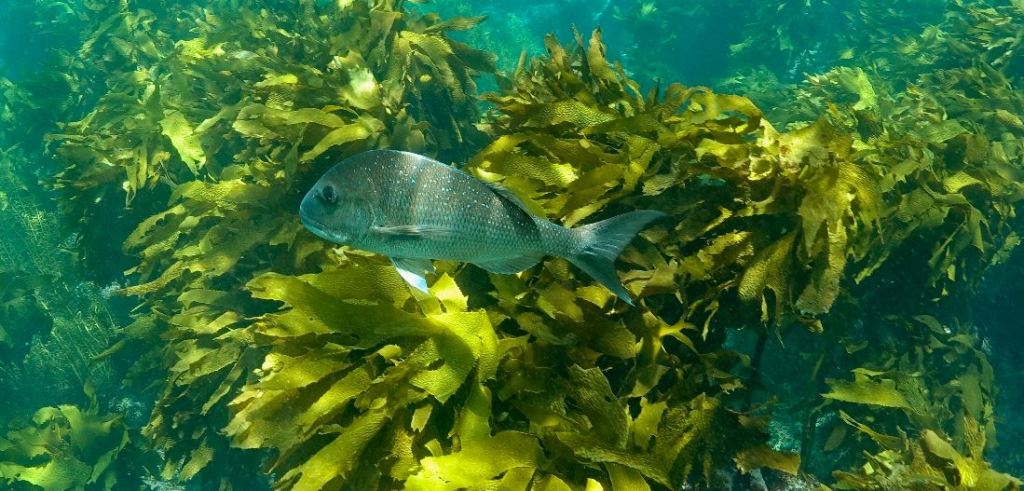
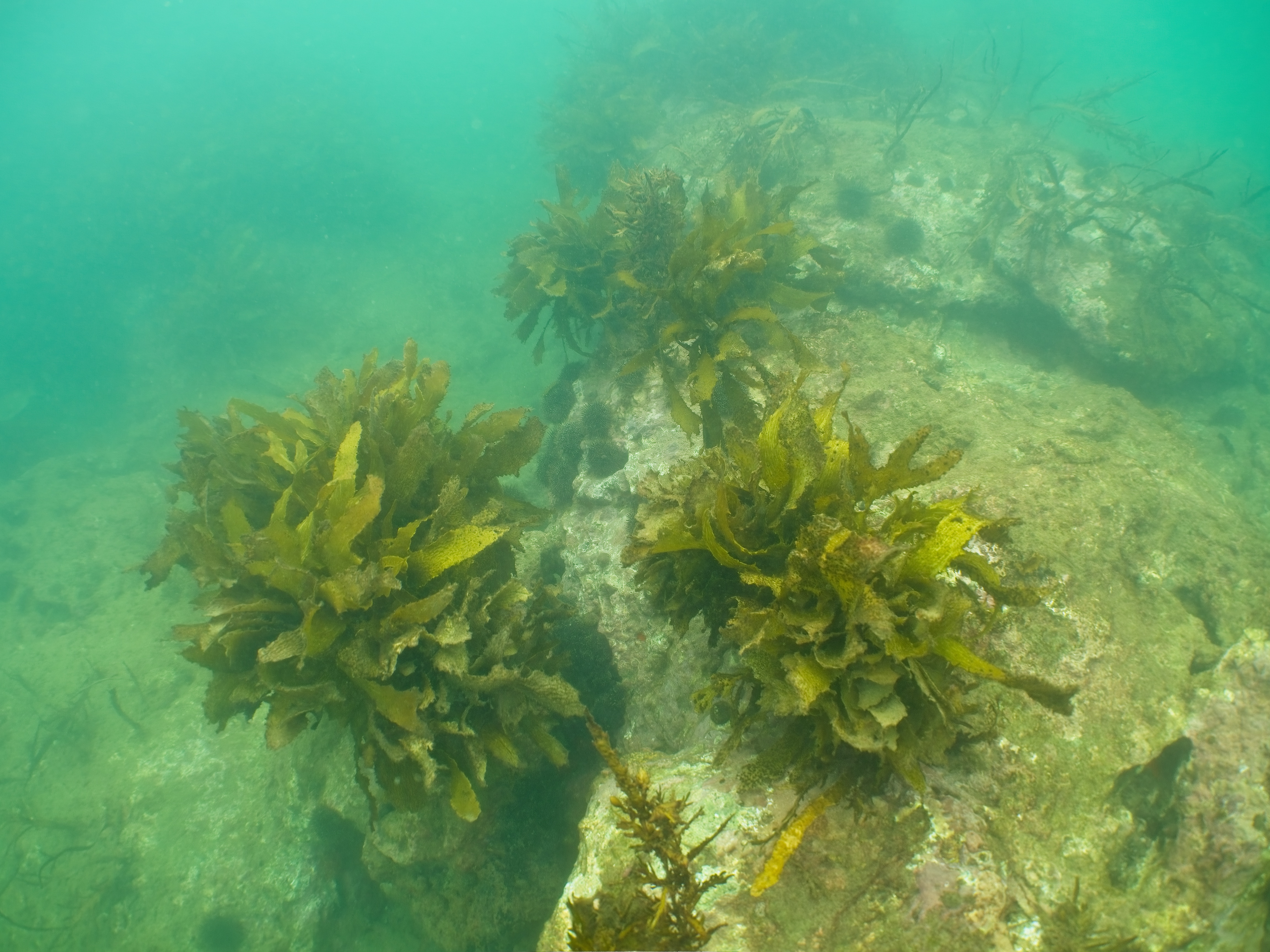
Tutukaka Harbour has been subject to sustained negative impacts over the past several decades, including substantial sedimentation from land clearing and development in the catchment, excess nutrients and pollutants from agricultural, domestic, and recreational sources and overfishing of ecologically important key species, such as kōura (crayfish) and tāmure (snapper).The result is a highly degraded ecosystem, dominated by kina barrens where there was once flourishing kelp forests, and a pronounced decrease in biodiversity of both fish and invertebrate life.
Ecklonia kelp forests are amongst the most important habitats for biodiversity and primary production in the coastal ecosystems of northern Aotearoa and their regeneration is a critical step in restoring the mauri of our coastal moana. While it is imperative that the underlying causes of overfishing and environmental impacts are addressed, this project aims to contribute to restoring the mauri of the harbour by investigating the potential benefits of “re-seeding” Ecklonia kelp forests in areas of the harbour that have been most impacted.

Who’s Involved?
This is a truly collaborative and community-focused project that draws on the deep relationship that mana whenua and other community members have with Tutukaka Harbour, and the shared desire to work towards restoring the Harbour to a state of vibrant health.
The project is being overseen by a hau kāinga steering group who are directly involved in the entire process including initial ecological assessments, site selection, kelp propagation and deployment, and ongoing monitoring. The lead organization for the project is Te Wairua o te Moananui – Ocean Spirit charitable Trust, a local organisation committed to the vision of a healthy moana in which human communities and the coastal ecosystems they inhabit thrive in mutually beneficial relationship.
The project is supported by researchers from Massey University’s School of Natural & Computational Sciences (Associate Professor in Marine Ecology, David Aguirre; MSc Student researcher, Beau Masters; MSc Student Researcher, Ella Lis), who are providing expert knowledge and support in the propagation, deployment and monitoring of the kelp.
Project Goals
The purpose of this project is to:
- Explore the viability of a community-based kelp regeneration programme.
- Develop and test kelp propagation and deployment methods.
- Observe and measure kelp growth rates and settlement success.
- Develop kina management methods to protect the kelp and uphold the mana of kina as a taonga species.
- Investigate the use of a community-based, ecological monitoring for informing decision making processes.
Goals include:
- Developing appropriate kaupapa and tikanga for the research and ongoing kelp regeneration work.
- Train community members in the collection of ecklonia reproductive tissue and propagation methods.
- Support the kaitiakitanga of mana whenua/mana moana.
- Contribute to the restoration of the mauri of Te Whanga o Tutukaka.
- Foster cross-cultural cooperation and understanding in relation to the moana.
- Provide educational opportunities for the development of practical ecological regeneration skills.
- Foster place-based ecological literacy.
- Develop a kelp restoration process that can be shared with other communities around the motu.
Methods
Kelp Propagation:
The kelp propagation process will be based onshore at Church Bay, using a modified refrigerated shipping container. The juvenile kelp will be grown in temperature-controlled, and sterilized sea water tanks under controlled lighting conditions. The reproductive tissue will be collected primarily from beach-cast kelp from the harbour and local coastline to maintain the whakapapa of the local kelp forests. The reproductive tissue is cleaned to remove contaminants then placed in the sea water tanks where the natural fertilization process of the kelp will occur.
Two different methods will be used for providing a substrate for the baby kelp to attach to: “green gravel” and a specially designed, porous string. The “green gravel” consists of locally sourced, small rocks from around the harbour, which are placed in the sea-water tanks with the reproductive tissue. The lengths of string are placed onto a frame which is then placed in the sea-water tanks.


Deploying the juvenile kelp once it has been propagated:
Once the juvenile kelp plants are well established on the substrates, they will be deployed at the trial sites in the harbour. The two initial trial sites are at Philip Island and Shag (Becks) Bay. The green gravel will be placed amongst suitable reef areas at depths ranging from 2 to 4 metres, initially around Philip Island. The string will be wound around a 10m rope array, situated close to the reef along the northern side of Shag Bay at a depth of 2 to 5m. This is a permitted activity that has been approved by NRC.

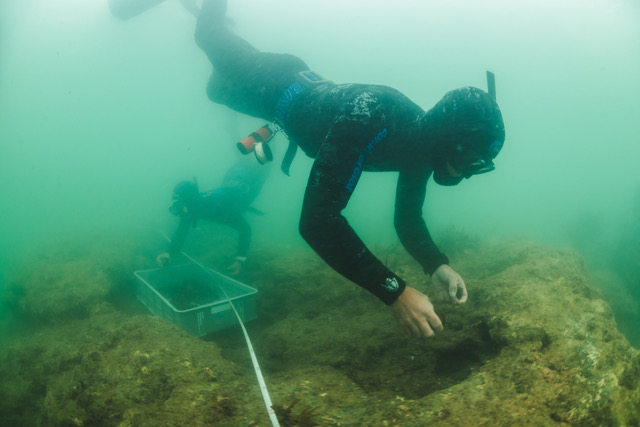
‘Green gravel’ kelp deployment in Tutukaka Harbour
Monitoring the growth of the kelp: The monitoring of the kelp will be both quantitative and qualitative.
The quantitative monitoring will be carried out by Massey University researchers, who will measure detailed growth rates, survival and settlement rates as well as quantitative water quality and other ecological indicator measurements. Mana whenua and community participation in this quantitative monitoring is welcome and encouraged.
The qualitative monitoring will be carried out by mana whenua and wider community volunteers with the support of Te Wairua o Te Moananui – Ocean Spirit Trust and with the participation of Auckland University PhD researcher, Glenn Edney. It is envisaged that this qualitative monitoring will be based on the Hauora Moana survey methodology, which can be modified to fit the specific needs of the community.
Update 2025
Now in its third year, the kelp project has provided us with plenty of challenges, from failed green gravel batches to cyclones, but along the way we have learned a lot and importantly, we can see the results on the reef at Philip Island. The before and after photos below show what is possible.
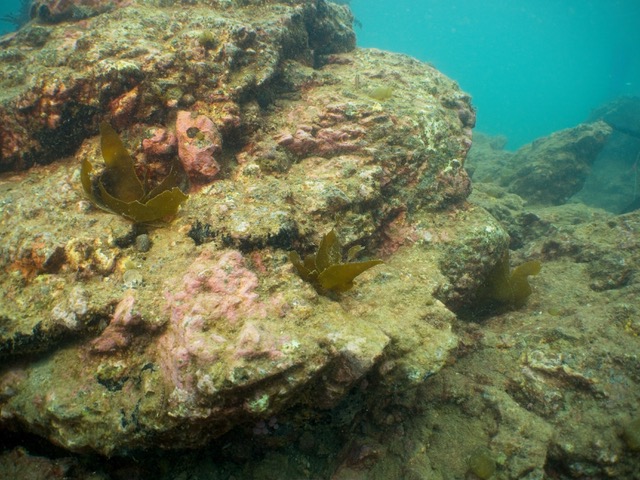
after deployment
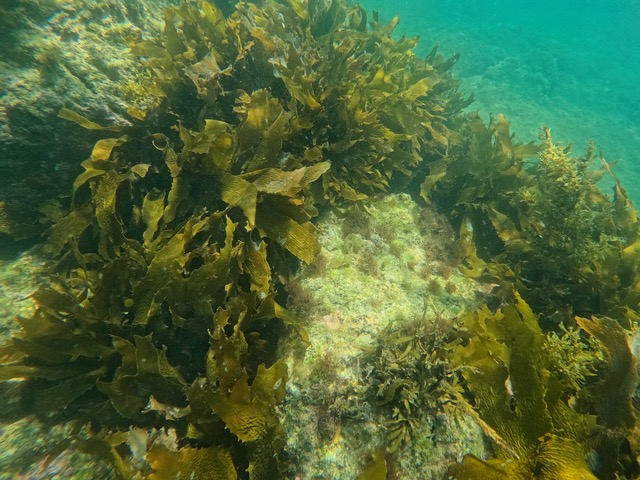
Photo taken 25th November, 2024.
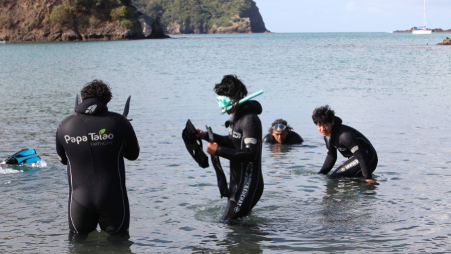
The project has also provided a brilliant educational platform and we have enjoyed hosting many groups, including schools, outdoor education providers, conservation groups, even retired master mariners.
We have collaborated with Papa Taiao Earthcare, Mountains to Sea Trust and The Whitebait Connection to provide hands on experience for rangatahi in ecological regenerative practice. Combining the kelp regeneration project with our Hauora Moana monitoring programme we have also co-facilitated seaweed education days with the wonderful team at Experiencing Marine Reserves (EMR).

 Te Wairua O Te Moananui